David and I have checked every list at least twice, but the frisson of nervousness that started yesterday is still there.
The bags may look as though they are listing a bit, but they are ready to go with everything we think we'll need for the next three weeks. And the scale tells us they are within the airline's weight limits. Phew....
Next stop, London!
Tuesday, April 24, 2012
Monday, April 23, 2012
France and England on $98 a Day - Las Vegas First
What
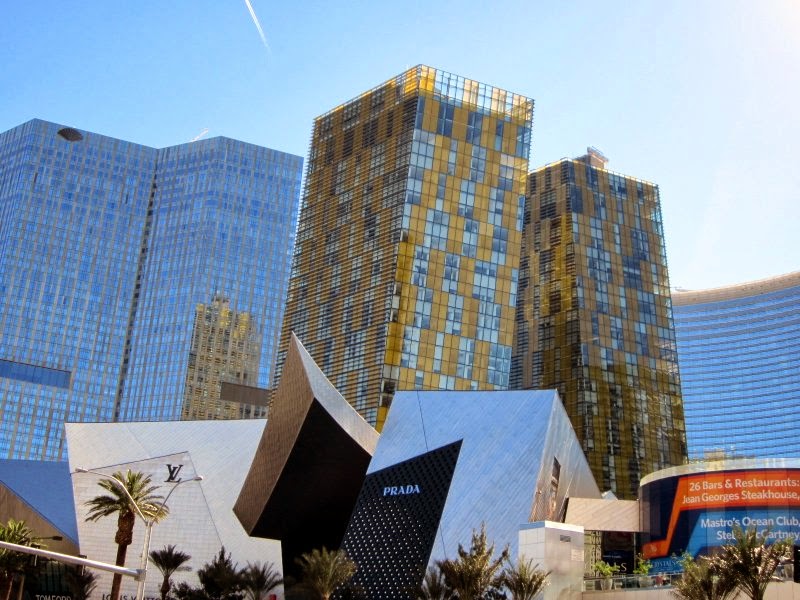
do Las Vegas and London have in common? Absolutely nothing. But
David's Just for Openers convention meant we had to go.
The
place makes you want to scream for help because your senses are
violated at every turn. Music blares from speakers lining the
streets, buildings careen at odd angles, lights blaze wherever you
turn, and boys in sunglasses thrust little packets of photos in your
face. Las Vegas is where brass trumps charm.
It's
full of excess. The meek have no place in Vegas. While the Bellagio
Hotel and Casino gardens are reliably lovely, that's the only area of
The Strip that is tasteful.
White
clouds and blue skies never change in the Miracle Mile Mall
shops--not even when it's "raining" every hour on the hour
into the pond below.
The
All Saints Spitalfields avant-garde clothing shop has 1,800
old-fashioned sewing machines dressing its considerable storefront.
This
man, Art Santen, is in The Guinness Book of World Records. He has
over 32,000 bottle openers. Yes, bottle openers.
We met
a man from the California Coast who said he towed his boat to a Vegas
parking garage. He roamed the streets during the day and retired to
his private yacht every night to sleep.
We met
only one man who tilted at windmills, trying to sell his photocopied
booklets of poetry to passersby.
I'm
delighted that what happens in Vegas stays in Vegas because I
couldn't pack all the brash bravado of that city in my suitcase no
matter how large the bag.
Practicalities -
Sunday, April 15, 2012
France and England on $98 a Day - Suitcase Security
I love taking the train in Europe. I don't lie awake the night before wondering whether the diet I imposed on my suitcase did the trick or if it will be declared overweight. There's no panic about my luggage ending up in Peru when I'm in Paris. And I'm pretty sure no one will rifle through my underwear during a layover in Lisbon since no one else will touch my luggage except me--and David if he's feeling chivalrous.
In fact, the only aspect of rail travel I do worry about is the getting-off-the-train part. That's when I think it might be easy for someone in a hurry to accidentally grab my suitcase instead of his and be on his way before I even know what's happened. This occurs because the luggage compartment above the seats is narrow so most people store their bags in the area at either end of the train car. There are so many suitcases clustered together it would be easy to mistake one anonymous black bag for another. Mistakes are made. Then, too, of course, a thief would have no problem grabbing a bag and hopping off the train before David or I even got down the aisle.
So, we have decided to ensure worry-free train travel. We've got a handy-dandy cheap solution to the Mistaken Bag Problem, and it's guaranteed to foil thieves, too. We're going to wrap this luggage strap through the handles of our suitcases after we shove them into the train car luggage area and thread it through the luggage rack slat one time before locking it.
It may take five minutes to undo the whole contraption at the end of the trip and make us the last stragglers off the train, but it will be worth it to know that we'll be leaving with the same suitcases we started with.
Thursday, April 12, 2012
France and England on $98 a Day - Our GPS
I have an unerring sense of direction. My instincts are always correct and never fail me. If I know deep in my bones, without a shadow of doubt, and beyond deliberation that I should turn right, then the only sensible thing to do is turn left.
It's uncanny how I can be so accurate, yet David seems unwilling to trust my directional proclivities on this trip driving the back roads of France. He seems to think we need additional verification that we're on the right routes to get us from Vernon to Dinan and on to Calais.
So, to satisfy him, we have investigated global positioning system, GPS, devices. Unfortunately, most of the rental offices in the little town in Vernon near Giverny, home of Monet's water lily gardens, do not carry cars equipped with GPS. EuropCar does offer it for $178.13, but we'd rather get lost than pay that amount.
We called our rental company, Avis, and inquired. A spokesperson today assured us they offer the service, but another agent two months ago just as confidently promised us they did not. I guess we won't find out who's right until we get there.
We also thought about downloading the European maps to one of our United States GPS devices, but according to advice on travel forums, that may or may not be successful. Spending $79 to find out is too high a price to pay.
David isn't taking any chances. He's used mappy and viamichelin.com (European mapping services similar to Mapquest here in the USA.) to plot our routes, we've received instructions from our hosts on how to reach our accommodations, and I bought several detailed Michelin road maps at the library used-bookstore. And if all else fails, he can simply ask me which way to turn and then go the opposite way.
Thursday, April 5, 2012
France and England on $98 a Day - London's Ceremony of the Keys
The United States has a lot going for it with abundant natural resources, an ingenious populace, and clever inventors who regularly change the way we live with new technology.
Here's some information about the ceremony and ticket procedure, and here is the official government website.
What it doesn't have is much pomp and circumstance. With only 235 years under our belt, we just can't compete with a country like England that's been studying Miss Manners for a thousand years or so.
And when it comes to ritual, the Brits brook no nonsense. They have ceremony down pat. If a ritual works well the first time, they see no need to ever change it.
Have you seen the commercial where the woman feels so wealthy with her new credit card that she tries to buy the Crown Jewels? Hundreds of years before that woman ever thought of approaching the Beefeater in the Tower of London, a ceremony to secure Britain's wealth was born.
The Ceremony of the Keys is a fifteen-minute ritual that locks all the doors in the Tower. It's been enacted every night in exactly the same way with the exact same words following the exact same footsteps of the first Yeoman Warder for over seven hundred years!
And every night a few lucky people are invited to share in the securing of the jewels. David and I will be among them one night in early May. We can't take photos, but I promise to tell you all about it in the blog.
Practicalities -
The tickets are free. All we had to do was send a request a couple months in advance with a self-addressed (stamps-enclosed) envelope. The only somewhat challenging part of the request process was acquiring the stamps needed for the return address. Obviously US stamps are not accepted by the British postal system, so we had to go to our post office to buy international stamps that the office in Britain exchanged for their British equivalent.
Here's some information about the ceremony and ticket procedure, and here is the official government website.
Sunday, March 25, 2012
France and England on $98 a Day - Our Accommodations
Finding accommodations in seven different locations wasn't easy, but after a longer search than usual, we found some economical places that are also unique. We will stay in one hotel, two gites--a traditional Bretagne granite house built in 1900 and a gite that began life as a barn in the 16th century--a garden flat in fashionable Notting Hill in London, and three B&Bs, one of which was converted from a former convent.
Not only are the accommodations diverse, but the prices are within our Tightwad budget, too. The B&Bs plus one night's hotel average around $100 a night ($50 per person) while the gites and London flat average slightly more at $110 per night ($55 per person). Since one of the top-rated London hostels, the Oxford Street YHA, charges $63 per night per person for a private twin-bed room with a shared bathroom, I think our $55 is a bargain.
The price is even more of a bargain considering all the advantages of having our own place. We'll enjoy en suite bathrooms, free wi-fi (The Oxford Street hostel charges extra for an Internet connection.), room to spread out and relax, a washing machine (We'll be able to take fewer clothes because we can wash them frequently.), and, most importantly, we'll enjoy the money we save by preparing our own food.
Maybe our accommodations aren't the stuff of headlines, but David and I think they should be!
[Note that all prices are quoted in US dollars with an exchange rate of €1 equals $1.30.]
Practicalities -
A gite used to be defined as a simple rural vacation cottage, but the term now includes much more luxurious lodgings as well. Today, a gite might be a ten-room villa overlooking the sea or a stylish apartment on the outskirts of Paris.
Tuesday, March 13, 2012
France and England on $98 a Day - Accommodations
Jaime and I met for lunch last week to talk about our upcoming trips. She is an artist who will spend two or three months traveling in early summer from the beaches of the French Riviera to the fjords of Finland. Since she is lucky enough to have been born French and still has relatives in several European cities, she only needed to find accommodations for a few places. She has discovered, as I have, that the very best and least expensive accommodations are apartment rentals.
Practicalities -
The Airbnb site is full of helpful information, FAQ, and even videos.
In a conversation this morning with Rachel J, a company representative, I was told the best way to handle reservations was to use the "Contact Me" button on the site to e-mail the host. After viewing the photos, reading the apartment description, and going over other people's reviews, you can deal directly with the host about any other questions you might have. When you are satisfied that you've found exactly the right rental, then use the "Book It" button to confirm your choice.
One of the major advantages to Airbnb is that there are multiple ways to pay the rental fee. All major credit cards, PayPal, or e-check are acceptable.
I also really like the way security deposits are handled by Airbnb in the case of long-term rentals. A guest's credit card is authorized 24 hours before the reservation begins and credited back to the card within 48 hours of the guest's departure. Using the credit card carries its own safeguards and so does having Airbnb handle the transaction. In the case of damage claims, Airbnb mediates with the guest and host until matters are fairly resolved.
Here is an article by Linda Lacina that recently appeared in Smart Money magazine about the pros and cons of the apartment rental market.
| Dining area in our Rome apt. |
While David and I prefer one of the Home Away/VRBO listing services, (I'll tell you about our rentals for this trip in upcoming posts.) Jaime, who often travels solo because her husband must stay home, thinks Airbnb is best. Renting a room in someone's home can be extremely inexpensive and a built-in friend/host often comes with the accommodation. After weeks of independent travel, it can be comforting to know there will be someone at "home" to hear all about your day's adventures.
Jaime says she has filed a "User Profile" because she wants potential hosts to know she is a mature, professional woman who will treat their property as respectfully as she would her own. She would want to know the background of anyone staying in her home, so she assumes her European hosts feel the same.
One of the aspects of the program she particularly likes is that her rental money goes directly to Airbnb and will not be sent to the host until after the first day. Not releasing the funds until the second day is the company's way of guaranteeing that the guest is satisfied with the accommodation. If the apartment has been misrepresented, then Jaime's money will be refunded any time within that first 24-hour period. The company would also help her find another place to stay.
This kind of reassurance, the ability to use credit cards, and the friendliness of Airbnb hosts will leave Jaime free to concentrate on her art. Instead of worrying about arranging for rooms in impersonal hotels, Jaime will feel "at home" wherever she goes in Europe.
Practicalities -
The Airbnb site is full of helpful information, FAQ, and even videos.
In a conversation this morning with Rachel J, a company representative, I was told the best way to handle reservations was to use the "Contact Me" button on the site to e-mail the host. After viewing the photos, reading the apartment description, and going over other people's reviews, you can deal directly with the host about any other questions you might have. When you are satisfied that you've found exactly the right rental, then use the "Book It" button to confirm your choice.
One of the major advantages to Airbnb is that there are multiple ways to pay the rental fee. All major credit cards, PayPal, or e-check are acceptable.
I also really like the way security deposits are handled by Airbnb in the case of long-term rentals. A guest's credit card is authorized 24 hours before the reservation begins and credited back to the card within 48 hours of the guest's departure. Using the credit card carries its own safeguards and so does having Airbnb handle the transaction. In the case of damage claims, Airbnb mediates with the guest and host until matters are fairly resolved.
Here is an article by Linda Lacina that recently appeared in Smart Money magazine about the pros and cons of the apartment rental market.
Wednesday, March 7, 2012
France and England on $98 a Day - Itinerary
| Metro in Paris |
Since we've always wanted to take the Eurostar which travels under the English Channel, we'll take that train to Paris after our overnight flight to London. It's possible to buy a ticket 120 days in advance, and the earlier the purchase the more the ticket is discounted. Buying our Eurostar tickets months in advance meant we saved 50% off the usual price!
We didn't want to rent a car in Paris and have to deal with traffic snarls, so we next had to find a small French town that was easily accessible from Paris. Vernon seemed to be the answer. It's only 45 minutes from Paris, easily reached by train, and is the gateway to Giverny where Monet's house and gardens are located. Starting our trip in such lush, inspirational surroundings will be an auspicious beginning we hope.
Driving the car to Brittany should be easy. After touring Giverny, we're heading to Dinan, one of the best preserved and still functioning medieval cities in France. Our rental house is within walking distance of the ancient town so we plan to park the car and explore on foot. We'll also take in as much of Brittany as we can on daily drives.
We follow that town with a trip to the countryside in Normandy. Our gite near Picauville and St. Mere Eglise will put David in the center of the battle area he longs to see.
Monday, March 5, 2012
Where Guidebooks Fear to Tread
| Michelin's map of Brittany |
Actually, guidebooks do exist about a couple of the lesser known places on David's and my itinerary this spring, but we had to special order them. While several books about European countries crowd the library shelves, there were none about the Brittany and Normandy areas of France.
Still, we were undeterred. I've wanted to see Brittany ever since I read Mark Greenside's intriguing book, I'll Never Be French. When I wasn't laughing out loud about his attempts to understand French culture, I was delighted by his description of an area that seemed to jut away from France like some rogue appendage, 150 miles out to sea. A place where rivers meander aimlessly but, nevertheless, charmingly, down to harbors clustered with sailboats. Not only is the whole of Brittany dotted with cobblestoned old cities and a few castles while a rugged coastline jogs along its perimeter, but it's inhabited by independent folks of Celtic and French descent. Add culinary treats like crepes and galettes (made from buckwheat), artisanal cheeses, and special buttery cakes called kouign amann, and you can see why I absolutely have to see this part of France.
David's goals are more noble. He's wanted to visit the Normandy battlefields since his dad first told him about World War II. He wants to walk every battle site, linger at the museums, and see the town where The Longest Day parachutists were shot as they floated down from the sky. We've scheduled four nights near Picauville, but it may not be long enough for him.
Friday, January 27, 2012
Wheels for Less
For getting around in the city, this woman in Florence, Italy, has the right idea!
The countryside is another matter, though. Bike riding means you cover little territory per day while you cannot rely on public transportation because it is often non-existent. Getting from one village to the next is problematic unless you rent a car.
A 23 January 2012, e-mail article on Budget Travel suggests using a car consolidator. In the article, "Can You Spot the Travel Rip-Off?" (Click here if you'd like to take the quiz.), the author says, "...many agencies act as consolidators, or legitimate brokers, for rental-car brands. These include Argus Rentals, Auto Europe, Kemwel (a sister company to Auto Europe), Nova, and Tiger Car Rental. Because consolidators buy deals in bulk, the savings they're able to offer can be dramatic."
I agree with Budget Travel that this has often been true in the past, but the advice doesn't seem to be on target this year.
The countryside is another matter, though. Bike riding means you cover little territory per day while you cannot rely on public transportation because it is often non-existent. Getting from one village to the next is problematic unless you rent a car.
But which car rental company offers the best deal?
A 23 January 2012, e-mail article on Budget Travel suggests using a car consolidator. In the article, "Can You Spot the Travel Rip-Off?" (Click here if you'd like to take the quiz.), the author says, "...many agencies act as consolidators, or legitimate brokers, for rental-car brands. These include Argus Rentals, Auto Europe, Kemwel (a sister company to Auto Europe), Nova, and Tiger Car Rental. Because consolidators buy deals in bulk, the savings they're able to offer can be dramatic."
I agree with Budget Travel that this has often been true in the past, but the advice doesn't seem to be on target this year.
Subscribe to:
Posts (Atom)