Tuesday, May 8, 2012

France and England on $98 a Day - Honfleur

David and I have come full circle after an 800 or so mile detour.   We started following the Seine River outside of Paris in Vernon, and after touring the areas of Brittany and Normandy, we've arrived at the river's end--where the Seine meets the English Channel in the port city of Honfleur.

This town has always been important to sailors because of it's protected harbor, and it served as inspiration for artists, especially Eugene Boudin (There's a museum devoted to his work.) and Monet, but today it seems mostly to cater to tourists.  There are souvenir shops everywhere, higher prices than the rest of Normandy, and traffic snarls even in the off-season.

Sunday, May 6, 2012

France and England on $98 a Day – Our Spacious Home in Normandy

Ben and Jay, the delightful owners of the Manoir de Founcroup and Les Herissons, the barn from which our gite is fashioned, says these buildings have been around since King Henry the 8th was speed dating, but we have enjoyed every amenity while still appreciating the place's heritage; the wooden beams, the two-foot thick walls, and the massive fireplace, where a woodstove now rests, constantly remind us of the house's roots.
A painter would be happy here as each of the windowsills holds a still life, but the practical aspects of a vacation have been remembered. No detail has been overlooked. Baskets of jam jars rest on the kitchen sideboard, juice, milk and butter are stocked in the fridge, and there are several cookbooks, one of which is opened to the seasonal recipes celebrating the month of May. Upstairs, candles are clustered on the edge of the huge bathtub ready to cast a romantic glow for that leisurely soak.

France and England on $98 a Day – Omaha Beach

At Omaha Beach, char a voile, low-slung three-wheeler contraptions with a seat and a sail, scuttle across the sand like crabs—just one of the twelve leisure activities available. Vacationers can enjoy the four-mile beach, hotel, snack shops and sport equipment while, just up the hill, almost 9,500 Americans lie buried at the American Military Cemetery and Memorial.
Parachutist hanging from church in St. Mere Eglise

Normandy is full of juxtapositions like this. Everywhere, in thriving cities large or barely visible on a map, are memorials of the war, from the American parachutist who got caught on the church steeple in St. Mere Eglise (A figure still dangles along with his billowing chute. See the movie, The Longest Day, for more details.) to tiny Picauville's memorial to downed American pilots.
Picauville's Memorial
The French clearly know that getting on with the future requires a remembrance of what has come before. In this part of France, they do both well.

They donated the Omaha Beach land north of the holidaymakers' beach to the US government in 1979, and the resulting memorial and cemetery is impressive and inspiring. The path from the parking lot through landscaped grounds filled with flowering shrubs and manicured trees leads the visitor to the two-level center where displays, films, and memorials recount the events leading to D-Day. The biographies of certain soldiers and the stark passageway of gray walls where the names of the dead are endlessly recited personalize the war, while graphic details of the logistics required to bring about the largest invasion in history that eventually lead to Hitler's defeat are recounted in several multi-media panels.

After leaving the visitor center, David and I walked along the path overlooking the beach on our way to the cemetery. We envisioned the scene from the movie, Saving Private Ryan, because veterans say it is the most accurate depiction of that morning, 6 June 1944, when so many Americans died. As we imagined the men facing the challenge of traversing that wide, golden beach with the enemy ensconced behind bunkers up on the ridge, the visitor center, closing for the day, played Taps. David and I both wiped away tears.
We thought we were emotionally prepared for the cemetery, but, then, I suppose nothing prepares you for the sight of white stone crosses and Stars of David as far as the eye can see. As if by prearrangement, David and I wandered apart, each going a different way through the rows and rows of memorials, able to cope only with our own thoughts. Dazedly, we walked past one and then another and another white marker. By the time dusk was falling, neither one of us had found a way to escape the evidence of so much carnage.
Practicalities -
Don't skip the visitor center as it is a moving prelude to the cemetery memorial itself. There are bathrooms and water fountains inside the building as well as housed in a separate building near the visitor center. Everything, the parking, visitor center and cemetery, is free—as it should be.

Saturday, May 5, 2012

France and England on $98 a Day - Bayeux and Its Tapestry

David had to persuade me to go to the medieval town of Bayeux. I figured we'd get lost in a maze of city streets trying to find the museum housing the famous tapestry and might ruin our driving record. Thanks to David's skilled navigating, the man practically sprouts maps—both the official Michelin ones and detailed drawings of his own—by this time in our travels we'd only gotten lost twice. As the driver, I'd logged 400 or so non-lost kilometers and, except for that little tire fiasco, was feeling pretty smug about my talents. I wanted to keep it that way. But David was intrigued with the notion of seeing Harold, in stitches, suffering his just punishment at the hands of William the Conqueror; off we went on an overcast morning.

Our few days of warmth and sunshine—we toured Mont St. Michel in 80 degree weather—seemed to be over as we were back to overcast skies, intermittent rain, and 9 C temps. I figured at least the museum would be indoors. And well-heated.
I'm delighted to report that the Tapestry was a wonderful surprise. The museum (admission 7.80 €) supplies a free audio guide that explains each of the 58 panels depicting Harold's hubris and resulting fall from grace.  Not to embroider the story, but the scenes in this 68-meter tapestry showing how William conquered Harold and England in one tumultuous battle are really quite detailed. David and I enjoyed the history lesson.


France and England on $98 a Day - Why We Rent

Kitchen window overlooking garden.
Our Dinan stone house, built in 1900, with its foot-thick walls and curving wooden staircase, was difficult to leave. From the street it looked as though it were a typical rowhouse, but, once inside, the house welcomed with spacious rooms, generous windows and glass doors that led to the garden.

The kitchen didn't have granite countertops or stainless steel appliances, the floor was linoleum, and the walls were papered with tiny blue figures stenciled on a white background. In short, the kitchen had none of the features Home and Garden television viewers want. But sitting at the table for six and looking out the glass door or the window near the sink into the garden beyond where iris, lily of the valley, azaleas, and gladiolas bloomed, David and I thought this kitchen one of the most beautiful we'd ever seen.

We lingered over breakfast even though we had much to do. We carried our suitcases down the stairs with one of us on each end to make them manageable. (I promised myself yet again that some day I'll learn to pack light.) Then we tidied up as best we could. Cleaning is not usually required in a gite, but Armelle and her husband had treated us so kindly we wanted to make sure the place looked as good when we left as it had when we arrived.

As we worked, we admired Armelle's paintings yet again. She has decorated the house with her colorful watercolor scenes, and David and I hoped to buy one at the market as we left town. Of course, getting to the market was dubious as it required navigating Dinan's serpentine streets, but I was determined to try.

Wednesday, May 2, 2012

France and England on $98 a Day – Mont St. Michel

You'll recognize the romantic image even if you don't know its name. Rising from the flatlands of white sand, from a distance Mont St. Michel shimmers in a magical light, seemingly conjured by a giant deity specializing in improbable castles birthed by the sea.

Actually the “castle” at the top of the island is an abbey for monks, founded in the 8th century by Aubert, the bishop of Avranches. The site of many miracles, it became the destination of pilgrims for over a thousand years. Because of its many defenses, it is also the only fortress in northern France that didn't fall to the English in the Hundred Years War. Mont St. Michel's history and beauty earned it, in 1979, a UNESCO World Heritage Site designation.

The Abbey maintained its mystery and isolation for centuries due to geography. Until the causeway was built, if visitors weren't careful and failed to remember that fifty feet high tides rendered Mont St. Michel an island, they could be stranded until low tide. Today, with the causeway, acres of parking lots, and shuttle buses, a visitor's main fear is not being stranded, but being overwhelmed by the tourist kitsch. Shops touting tchotchkes line the only street on the island. Still, the place is stunning, and one of the most popular tourist sites in France, second only to the Eiffel Tower.

France and England on $98 a Day - Mustard Fields

The lavender fields are on my must-see list, but, until I have that chance, the mustard fields will do nicely.  David and I have seen them stretching for acres all over this part of France.

Tuesday, May 1, 2012

France and England on $98 a Day - May Day/Mayday

Storybook-perfect days happen and May Day was one of them. 

David and I enjoyed the crisp air as we walked from our hundred-year-old Bretagne house to the center of town where boys stood on street corners selling tiny bouquets of flowers for a euro or two. Of course, everywhere we looked, flowers added punches of lavish color to the lush green landscape; it wasn't hard to persuade ourselves to climb the stairs leading to the ancient city walls for a better view of this medieval city and its gardens.

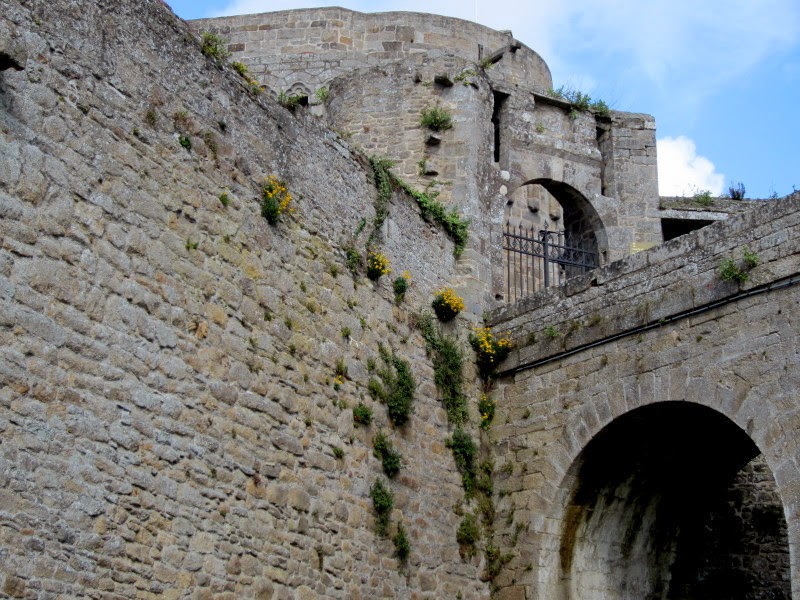
From the ramparts, the views were indeed spectacular. This trading city, established as a port in the 12th century, is one of the few not destroyed during the war. Its river scenes and twisting streets are the stuff of postcards, but what I particularly like about it is that Dinan is also a “real” town with people who live and work here and take pride in their place in history. This is not a town that only exists for tourists.

We visited St. Malo the other day and it was chockablock with gimcracky tourist stores. David and I prefer the honesty of a place like Dinan or one of the harbors like this one, visible all along the coast of Brittany.

Still, we would have been happy almost anywhere since the sun was shining and our mayday calls had been answered. Truly, the travel gods had sorely tested us during our first week of travel.

Tuesday, April 24, 2012

France and England on $98 a Day - Out the Door

David and I have checked every list at least twice, but the frisson of nervousness that started yesterday is still there. 

The bags may look as though they are listing a bit, but they are ready to go with everything we think we'll need for the next three weeks.  And the scale tells us they are within the airline's weight limits.  Phew....

Next stop, London!

Monday, April 23, 2012

France and England on $98 a Day - Las Vegas First

What do Las Vegas and London have in common? Absolutely nothing. But David's Just for Openers convention meant we had to go.

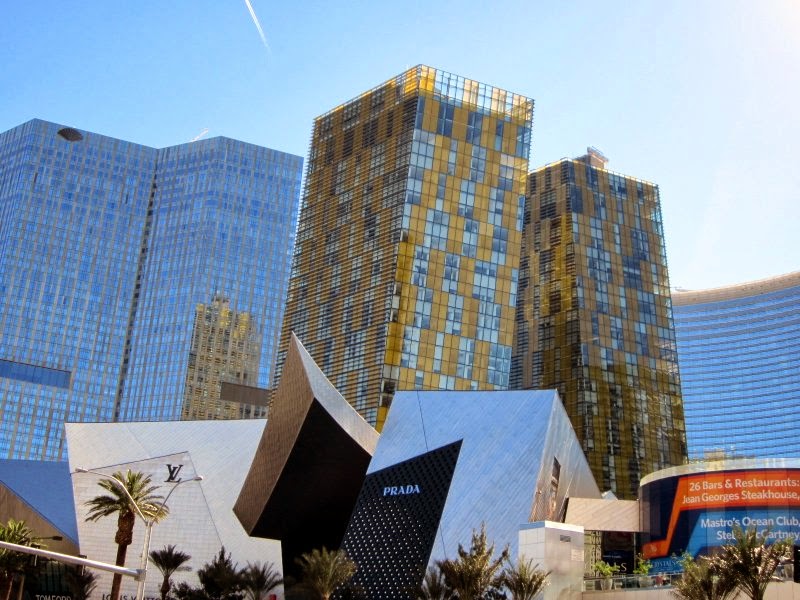
The place makes you want to scream for help because your senses are violated at every turn. Music blares from speakers lining the streets, buildings careen at odd angles, lights blaze wherever you turn, and boys in sunglasses thrust little packets of photos in your face. Las Vegas is where brass trumps charm.

It's full of excess. The meek have no place in Vegas. While the Bellagio Hotel and Casino gardens are reliably lovely, that's the only area of The Strip that is tasteful.

White clouds and blue skies never change in the Miracle Mile Mall shops--not even when it's "raining" every hour on the hour into the pond below.

The All Saints Spitalfields avant-garde clothing shop has 1,800 old-fashioned sewing machines dressing its considerable storefront.

The people who visit this town also intrigue.

This man, Art Santen, is in The Guinness Book of World Records. He has over 32,000 bottle openers. Yes, bottle openers.

These octogenarian twins still dress the same way every day.

We met a man from the California Coast who said he towed his boat to a Vegas parking garage. He roamed the streets during the day and retired to his private yacht every night to sleep.

We met only one man who tilted at windmills, trying to sell his photocopied booklets of poetry to passersby.

I'm delighted that what happens in Vegas stays in Vegas because I couldn't pack all the brash bravado of that city in my suitcase no matter how large the bag. 

Practicalities -
If you do go to Las Vegas, consider staying a block off the strip in one of the less frenetic hotels that doesn't have a casino.  We had a lovely room at the Carriage House, complete with its own kitchen.