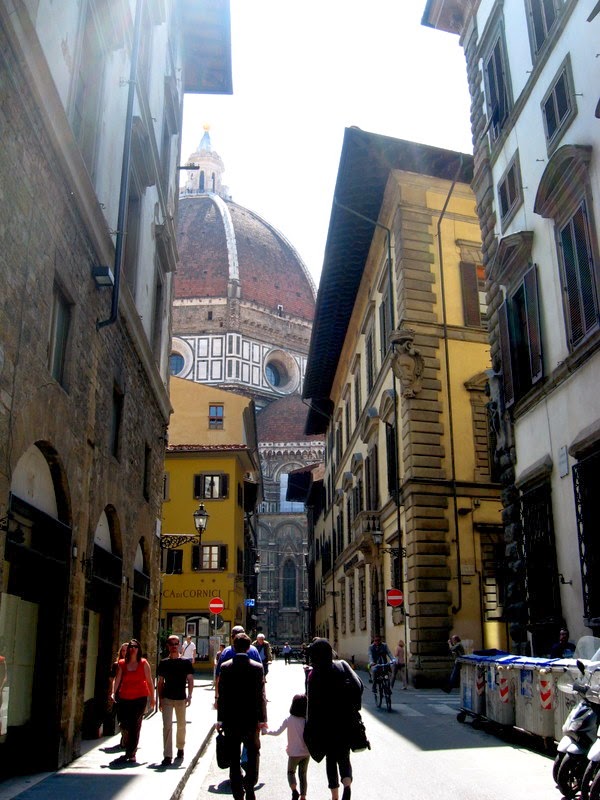
David and I waited in line for about ten minutes today to finally see the inside of the dome that dominates every view in this town. It's easy to understand why the architect, Filippo Brunelleschi, is considered a genius. Even Michelangelo was said to be in awe of it.
As beautiful as the Duomo is, there's an interesting surprise waiting downstairs. In addition to Brunelleschi's tomb and the inevitable gift shop, 3 euros earns you admission to the excavation of Santa Reparata, the original cathedral of Florence. This cathedral, which is seen as proof that Christianity existed in the 3rd century, was named for Saint Reparata, a virgin who was martyred when she was twelve years old for refusing to denounce her Christian faith.
We enjoyed seeing this early cathedral that seemed to serve as the footprint for the more modern Duomo as much as the Duomo itself. A one-euro video/audio presentation (There are two of these “stands” in the excavation with one screen and two hand-held earphone sets per stand.) told us about the history of the cathedral and its importance to Christianity.
Wednesday, May 11, 2011
Florence on $85 a Day – The David
No matter where you walk in Florence, you'll not only see the Duomo peeking around every corner, but David and his slingshot seem to follow you wherever you go. Replicas of him are everywhere—in piazzas, at souvenir shops, on T-shirts. Although he hasn't actually started riding the bus yet, I imagine that idea is being considered!
Of course, it's no wonder Florence is so proud of this most famous statue in the world. Michelangelo took a piece of marble that another artist had rejected and formed a masterpiece.
The David, in the Academia Museum, is housed at the end of a long hall. Lining both sides of that hall are statues that symbolize Michelangelo's theory that the art of sculpting is simply a matter of removing the superfluous rock material to free the statue within. A great master is simply one who can wield a chisel to reveal the inherent statue; the works lining this hall seem to be half-completed. The figures literally seem to be “coming out of” the rock.
Then, to maximize effect, there at the end of the hall, in a rotunda all by himself, is the giant David. And it IS impressive. But you'll have to take my word for it because no photos are allowed.
We sat on the conveniently placed benches for several minutes studying the great statue, noticing that his hands seem huge. I'd read somewhere that Michelangelo made David's hands larger than normal to show that God favored the young boy and that, with Him, anything, even slaying a nine-feet tall giant with a stone, is possible.
As wonderful as it was to finally see the “real” David, we also very much enjoyed two slide presentations offered on the second floor of the museum. The first showed the history of clothing and armor through the ages, and the second explained the steps –I lost track after the first six—an artist goes through to create triptychs or paintings on wood.
If you think you'd enjoy meeting David and gaining some insight into Renaissance art, consider ordering your tickets in advance to avoid the lines. We paid 21 euros for two tickets from the Firenze Museum site.
Of course, it's no wonder Florence is so proud of this most famous statue in the world. Michelangelo took a piece of marble that another artist had rejected and formed a masterpiece.
The David, in the Academia Museum, is housed at the end of a long hall. Lining both sides of that hall are statues that symbolize Michelangelo's theory that the art of sculpting is simply a matter of removing the superfluous rock material to free the statue within. A great master is simply one who can wield a chisel to reveal the inherent statue; the works lining this hall seem to be half-completed. The figures literally seem to be “coming out of” the rock.
Then, to maximize effect, there at the end of the hall, in a rotunda all by himself, is the giant David. And it IS impressive. But you'll have to take my word for it because no photos are allowed.
We sat on the conveniently placed benches for several minutes studying the great statue, noticing that his hands seem huge. I'd read somewhere that Michelangelo made David's hands larger than normal to show that God favored the young boy and that, with Him, anything, even slaying a nine-feet tall giant with a stone, is possible.
As wonderful as it was to finally see the “real” David, we also very much enjoyed two slide presentations offered on the second floor of the museum. The first showed the history of clothing and armor through the ages, and the second explained the steps –I lost track after the first six—an artist goes through to create triptychs or paintings on wood.
If you think you'd enjoy meeting David and gaining some insight into Renaissance art, consider ordering your tickets in advance to avoid the lines. We paid 21 euros for two tickets from the Firenze Museum site.
Tuesday, May 10, 2011
Florence on $85 a Day - The Duomo Is Everywhere
This is the view of the Duomo from our front door, but no matter where you go in centro you will see it peeking from behind the ancient buildings, tantalizing you with a glimpse here and there.
There it is again. And when you turn the corner and go down another street
you'll come across it yet again. It almost seems like a giant being playing
hide-and-seek. Dwarfing everything around it. Hiding in plain sight.
Until, finally, there is the masterpiece at last.
There it is again. And when you turn the corner and go down another street
you'll come across it yet again. It almost seems like a giant being playing
hide-and-seek. Dwarfing everything around it. Hiding in plain sight.
Until, finally, there is the masterpiece at last.
Florence on $85 a Day - Best City View
For the most sweeping views of Florence, take the # 13 bus from the central city area (the tourist area) to Piazzale Michelangelo. 
This is a well-known viewpoint with lots of kitschy tourist stands and over-priced food and drink, but the view makes up for all of it.
From Piazzale Michelangelo, you can see the Otrarno area where Boboli Gardens and Pitti Palace are located.
To get back to centro, take the #12 bus.
Practicalities -
Buy your ticket at any Tabacchi store. After you stamp the ticket in the machine on the first bus, you have 90 minutes more in which to use it again (no need to re-stamp), so you should only need one ticket to go to, and return from, Piazzale Michelangelo.
Tabacchi stores, dotting every street in Italy it seems, are very important spots for tourists. This is where you buy transit tickets, phone cards, and stamps.
This is a well-known viewpoint with lots of kitschy tourist stands and over-priced food and drink, but the view makes up for all of it.
From Piazzale Michelangelo, you can see the Otrarno area where Boboli Gardens and Pitti Palace are located.
To get back to centro, take the #12 bus.
Practicalities -
Buy your ticket at any Tabacchi store. After you stamp the ticket in the machine on the first bus, you have 90 minutes more in which to use it again (no need to re-stamp), so you should only need one ticket to go to, and return from, Piazzale Michelangelo.
Tabacchi stores, dotting every street in Italy it seems, are very important spots for tourists. This is where you buy transit tickets, phone cards, and stamps.
Monday, May 9, 2011
Florence on $85 a Day – Sunday Supper
| We didn't eat here. |
At the butcher stall, we saw what looked like chicken that had been marinated in spices. It looked enticing but what part of the chicken was it? Or was it even chicken?
The first butcher gave up trying to understand our fractured Italian and called his partner over. The partner couldn't understand us any better, but at least he was willing to go the distance. We struggled through several more sentences trying to guess 1.whether this was chicken and 2.what part of the chicken it might be.
After another lengthy discussion in which neither side understood the other, in desperation, I finally pointed to the delectable looking marinated chicken and then to my body. Before I got too graphic, the butcher grabbed a raw whole chicken, pointed to a spot somewhere between the leg and the back, and said, “Si, si.”
We frowned. Ah, so it was chicken. Just not the part we wanted.
Somehow, after five minutes of seemingly meaningless discussion and gesticulation, the butcher finally pointed to another area of the case where what looked like chicken breasts were nestled. He stabbed his finger at the appropriate spot on the raw chicken clutched in his left hand and then pointed back to the breasts. David and I nodded our heads, gave a thumbs up, and almost hugged the guy. We had our main course at last.
Sunday, May 8, 2011
Florence on $85 a Day – A Room with a View
| The view from the desk where I'm typing. |
The five of us were quite content to stay on the grounds most of the time, especially because every time we ventured anywhere we promptly got lost, but we did go several times to Florence. The drive that was supposed to be 45 minutes stretched to two hours every time because we found new ways to get lost each trip. Getting lost was made more bearable by telling ourselves that we were seeing different areas of Tuscany, but, still, getting lost was always a frustration, and we were always relieved to return to our peaceful paradise where we could sit on the terrace at night watching the stars and hearing only the very occasional rustle of a wild boar in the distant woods.
David and I are not staying in the country on this trip to Florence.
Saturday, May 7, 2011
Florence on $85 a day – Uffizi Museum
I can get lost in a hotel bathroom, but David has GPS built into his DNA. He was determined to lead us to the Uffizi Gallery, no matter what. And there was plenty of “what” to get in the way.
Our apartment fronts on a little piazza with two open-air dining areas and a flower stall where folks sit along the perimeter benches or stand in knots to discuss the day's events. We thought they'd go home when midnight rolled around, but all night we heard shouting, breaking glass, cursing and the occasional police car careening through a side street.
When we set off the next morning, we saw carabinieri on the corner of our piazza, and hundreds of people clogging the street with their red flags and banners. It seemed to be a loosely organized parade of some sort, but David, not to be deterred, pushed on. We came upon the Santa Croce Church and there was no denying that something big was happening. The entire piazza was packed with people. We snapped some photos but kept walking. We had an appointment at the Uffizi, and we'd come a long way to see the world-famous art collection.
We finally learned what was going on when we got to the museum. Italy's unions had organized the biggest all-day work stoppage in twenty years, and Florence hosted the most protesters of all. There would be no live TV broadcasts, no newspapers, no train, bus, taxi, or airplane traffic for the next eight hours.
No wonder the officials let us in the museum early. The usual number of tourists was absent because only foot-traffic had been able to navigate the streets. David and I were grateful we'd traveled by bus, train, and taxi on Thursday. If we'd tried to leave just one day later, we'd still be in Rome.
We were, I confess, feeling a bit smug about it all and congratulating ourselves on our timing as we wandered the halls of the great museum. We were not allowed to take photos, but the art left an indelible image in our minds.
Just as we were about to see the Rubens, the guard told us to get out. The museum was closing because of the strike.
Our apartment fronts on a little piazza with two open-air dining areas and a flower stall where folks sit along the perimeter benches or stand in knots to discuss the day's events. We thought they'd go home when midnight rolled around, but all night we heard shouting, breaking glass, cursing and the occasional police car careening through a side street.
When we set off the next morning, we saw carabinieri on the corner of our piazza, and hundreds of people clogging the street with their red flags and banners. It seemed to be a loosely organized parade of some sort, but David, not to be deterred, pushed on. We came upon the Santa Croce Church and there was no denying that something big was happening. The entire piazza was packed with people. We snapped some photos but kept walking. We had an appointment at the Uffizi, and we'd come a long way to see the world-famous art collection.
| Entrance to Uffizi |
We finally learned what was going on when we got to the museum. Italy's unions had organized the biggest all-day work stoppage in twenty years, and Florence hosted the most protesters of all. There would be no live TV broadcasts, no newspapers, no train, bus, taxi, or airplane traffic for the next eight hours.
No wonder the officials let us in the museum early. The usual number of tourists was absent because only foot-traffic had been able to navigate the streets. David and I were grateful we'd traveled by bus, train, and taxi on Thursday. If we'd tried to leave just one day later, we'd still be in Rome.
| View from Uffizi Window |
We were, I confess, feeling a bit smug about it all and congratulating ourselves on our timing as we wandered the halls of the great museum. We were not allowed to take photos, but the art left an indelible image in our minds.
Just as we were about to see the Rubens, the guard told us to get out. The museum was closing because of the strike.
Thursday, May 5, 2011
Rome on $85 a Day - Our Apartment
| view from apartment window |
Our apartment here in Monteverde, just a twenty-minute tram ride from the city center, has been a refuge from the crowds that practically knock you off the sidewalk downtown.
It's probably the largest place we'll have on this trip because we've practically rattled around in the three bedrooms, two baths, and generous living/dining/kitchen area. There was one glitch as we didn't get English BBC on the TV until yesterday, but otherwise we felt as though we were living in luxury.
| La Ristoreria di Frontoni |
Don't even get me started on Tony's where our daily 2 euro cup of gelato has been ample reward for fighting the tourist crowds in Rome.
And in the market, where we regularly buy groceries, the deli man has gotten to know us and offers a special taste treat every time we stop at his shop.
Ah, we will miss it all....but Tony, deli man, and Frontoni Restaurant, we will be back. We will definitely be back!
Practicalities -
We found this gem of an apartment on VRBO.com. number #282276
Tuesday, May 3, 2011
Rome on $85 a Day – Vatican Museums and Sistine Chapel
A tremendous amount of information exists about the smallest country in the world where 829 people live in .17 square miles, so there's no point repeating what you can learn in any guidebook or Internet site. What I will tell you are three tips that are not so widely available.
The most important advice is to get your tickets ahead of time from the Vatican Museum site. (Other ticket services exist, but they charge a hefty commission so there's little point in dealing with anyone but the Vatican itself.) David and I were at the Vatican on one of the slowest days of the week, Tuesday, (The other day is Thursday.) but the lines were long and the crowds claustrophobic-inducing. If you order tickets in advance, however, you avoid the lines altogether, and whip right into the museum in just minutes instead of hours. We paid 31 euros each for a guided tour, which I highly recommend as you learn quite a bit about the art collection from the docent, but you can buy a ticket for 19 euros per person to explore independently if you prefer.
| St. Peter's Basilica from Vatican Museum |
| Can you see why this is the Goddess of Fertility? |
Rome on $85 a Day – Ingenious Italians
David and I have enjoyed our penthouse apartment where the expansive windows make eating a meal a feast for the eyes as well as the stomach. And I know it will be with a sigh that we'll leave the neighborhood where the daily market has contributed to our culinary delight (along with Tony's across the street for the best gelato in Rome), but it is a cupboard in the kitchen that we'll miss most of all.
The cupboard over the kitchen sink consists of two shelves of racks with grates underneath. Although we have a dishwasher, we've had more fun washing the dishes by hand because the ingenious Italians have so simplified the process. We can wash a dish, put it up to dry, and put it away -- all at the same time. The water from the drying dishes falls back into the sink; the dishes don't have to be touched with a cloth; and they're cleaned, dried, and put away all in one move!
As clever as this modern-day invention is, the Italians have been practicing ingenuity all along. They were among the first recyclers, or, perhaps it's more accurate to say, re-purposers because they built a mountain out of a rubbish heap. This is how Monte Testaccio came about.
The cupboard over the kitchen sink consists of two shelves of racks with grates underneath. Although we have a dishwasher, we've had more fun washing the dishes by hand because the ingenious Italians have so simplified the process. We can wash a dish, put it up to dry, and put it away -- all at the same time. The water from the drying dishes falls back into the sink; the dishes don't have to be touched with a cloth; and they're cleaned, dried, and put away all in one move!
| Aerial photo of Monte Testaccio |
Subscribe to:
Posts (Atom)